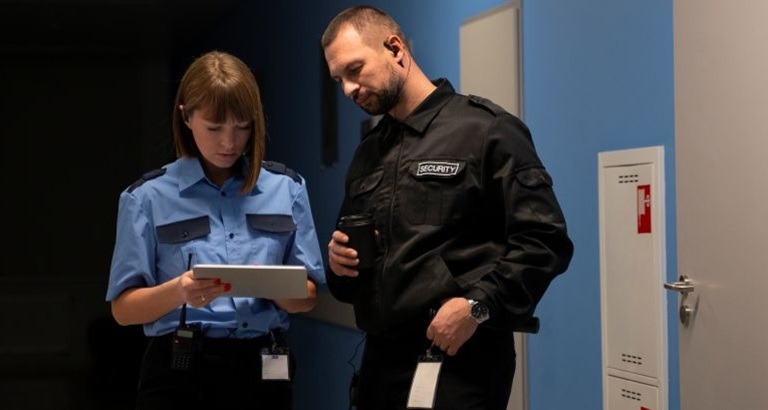
Discover security and law enforcement careers with a GED which are available in South Africa, including training routes, certifications and pathways to promotion.
For many young people who dream of wearing a uniform, protecting communities or building a future in law enforcement, the path can seem straightforward: finish high school, meet the language requirements, submit the application and step into training. The reality is often more complicated.
In South Africa, however, some government and professional roles require a National Senior Certificate and proof of proficiency in two official languages. Students who choose the GED route can therefore find that certain doors, particularly in state institutions such as the South African Police Service, are difficult or even impossible to open.
Yet a closed door in one place does not mean the end of the road. The safety, protection and investigative sectors are far broader than many families realise and the private and vocational landscape offers multiple ways to build meaningful, respected careers. Outside of government structures, many employers value practical ability, professional conduct, clean background checks and specialised certifications more than a traditional matric certificate.
With the right training, certifications and practical experience, GED holders can still step into roles that serve the public, develop specialist expertise and open opportunities for advancement or even business ownership.
Below is a practical roadmap to help you see what is possible.
Step 1: Build employability with targeted training
A GED on its own rarely secures a position, yet paired with vocational credentials it becomes powerful. Many of these courses are short, affordable and stackable, allowing a student to work and study at the same time.
Common starting points include:
- PSIRA (Private Security Industry Regulatory Authority) registration for private security work
- Firearm competency for armed roles
- Investigation or criminology short courses
- Occupational health and safety certificates
- Emergency medical or firefighter training
- Technical qualifications in CCTV, alarms or cybersecurity
These are the keys that unlock doors.
Step 2: Enter the industry
Once trained and registered, several entry level opportunities become realistic.
| Career / Role | GED Accepted? | Typical Requirements | Where It Can Lead |
| Private Security Guard | Yes | PSIRA registration | Supervisor, control room operator, site manager |
| Armed Response Officer | Yes | PSIRA + firearm competency | Senior response officer, operations management |
| Event / Venue Security | Yes | PSIRA | VIP protection, event security coordination |
| Investigative Assistant | Yes | Investigation courses, registration | Licensed private investigator |
| Municipal Law Enforcement | Sometimes | Municipal training academy | Traffic specialist, by law enforcement |
| EMS Technician | Yes | EMS certification | Advanced paramedic, station leadership |
| Firefighter | Yes | Fire training, medical fitness | Station officer, trainer |
| Security Systems Technician | Yes | Technical courses | Senior installer, systems consultant |
| OHS Officer | Yes | SAMTRAC or similar | Safety manager, compliance lead |
Notice how many pathways are open once a student focuses on industry specific qualifications rather than school leaving certificates.
Step 3: Grow into specialist or leadership roles
Experience changes everything. After a few years in the field, additional study can move someone into areas such as:
- Risk and loss control
- Corporate investigations
- Compliance and safety management
- Technical security design
- Training and supervision
At this level, reputation, reliability and competence often matter more than how a person completed high school.
Think of the progression like this:
GED → vocational training → entry role → experience → specialisation → leadership or business ownership.
Each step builds on the one before it. Each qualification increases responsibility and earning potential.
Navigate a Roadmap to Your Goal
While SAPS entry is unlikely with a GED, the private security sector, municipal law enforcement, investigative support, emergency services and vocationally certified roles are realistic alternatives. With a GED plus targeted short courses or certifications, career progression is still very possible.
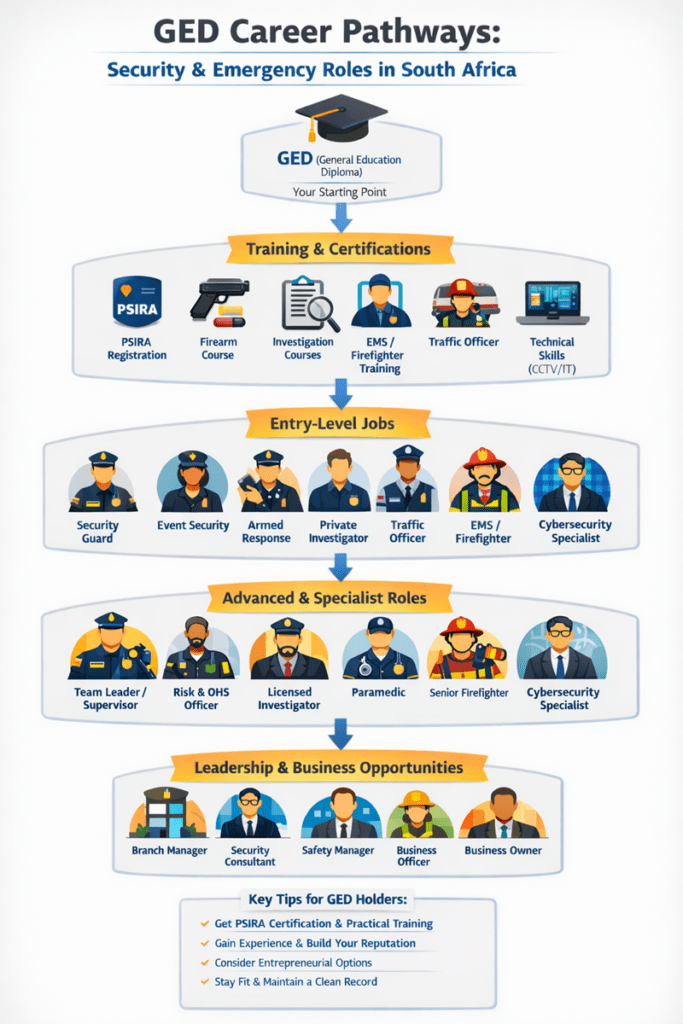
Here’s a clear, practical table of GED-friendly law enforcement, security, and related careers in South Africa, showing entry requirements, training/certification options and potential career growth:
| Career / Role | GED Eligibility | Required Training / Certification | Career Progression / Notes |
| Private Security Guard | Yes | PSIRA registration (private security course, 2–4 weeks) | Can advance to team leader, supervisor, or branch manager. Armed response requires additional firearm training. |
| Armed Response / Cash-in-Transit Officer | Yes | PSIRA registration + firearm handling course | Higher pay, physically demanding. Potential to move into supervisory roles or security operations management. |
| Event / Venue Security Officer | Yes | PSIRA registration | Can specialise in VIP protection or event management security. |
| Private Investigator / Investigative Assistant | Yes | Short courses in investigation, risk management, or criminology; registration with South African Council for Private Investigators | Can progress to licensed private investigator or security consultancy. |
| Municipal Law Enforcement / Traffic Officer | Sometimes (depends on municipality) | In-house training / short course | Can specialise in traffic management, by-law enforcement, or municipal investigations. |
| Emergency Medical Services (EMS) Technician / Paramedic | Yes | Short EMS courses; advanced paramedic requires further study | Career path includes senior paramedic, station officer, or training roles. |
| Firefighter / Emergency Response | Yes | Firefighter training at accredited centre; OHS and First Aid certifications | Promotion to station officer, fire safety trainer, or emergency management roles. |
| Risk / Loss Control Officer | Yes | Short courses in risk management, OHS, or corporate security | Can advance to risk analyst, consultant, or security manager. |
| Occupational Health & Safety (OHS) Officer | Yes | OHS certificate or diploma (e.g., NEBOSH / SAMTRAC) | Progression to safety manager, trainer, or compliance officer. |
| Security Systems Technician / Cybersecurity Support | Yes | Technical courses in CCTV, alarm systems, IT security | Can specialise in installation, systems monitoring, or IT security consultancy. |
| Entrepreneurial / Freelance Security Options | Yes | PSIRA optional (depending on role); other short courses beneficial | Start your own security company, private investigation, or training business. Growth depends on reputation, network, and certifications. |
Key Notes for GED Holders:
- A GED is generally accepted in the private sector but government roles requiring NSC or matric are restricted.
- Short courses, PSIRA registration or technical certifications can unlock supervisory or specialised roles.
- Practical experience and clean background checks are highly valued in security, investigative and emergency fields.
- Entrepreneurial pathways allow GED holders to bypass strict government requirements entirely.
What families should understand
Many parents fear that choosing the GED closes too many options. The truth is more nuanced. It closes some government routes, particularly those tied tightly to matric and language requirements, yet it opens flexibility, earlier work opportunities and the ability to pursue practical credentials quickly.
Students who are motivated, disciplined and willing to keep learning can build impressive careers.
In fact, the private security and risk sector often rewards initiative, maturity and continuous upskilling. Does the person arrive on time, complete reports properly, stay calm under pressure and treat people professionally? Those qualities create promotion.
A different way to think about success

If a young person wants to serve, protect, investigate or respond to emergencies, there is more than one uniform they can wear. There is more than one ladder to climb.
The GED may redirect the route, yet with the right plan it does not end the journey. Check out Where do GED Graduates Study
The important question becomes, what training will you add next?